nXu offers flexible lesson pathways so you can choose the experience that best fits your students, available instructional time, and program goals. Before choosing curriculum, be sure to connect with your school or organization's nXu liaison to understand your implementation plan, including if there is a specific Scope & Sequence and which lessons you'll be using. Once you've done that, you'll be ready to get started.
For middle school and high school (Grades 6–12), we recommend starting with the Selecting nXu Lessons guide, which walks you through a simple decision tree to identify a recommended Scope & Sequence. If you prefer to build your own sequence, you can also select lessons by reviewing module descriptions here. nXu recommends that in all secondary grades, the year starts with 2-3 lessons from Building a Culture for Purpose Work.
All lessons are designed for 25 minutes. You may choose to shorten, extend, or combine lessons as needed for your instructional blocks.
For elementary (Grades K–5), lessons are designed to be taught in a recommended sequence that builds skills over time. See below for the recommended sequence. You may find the module descriptions here.
The Kindergarten lessons are 20 minutes and Grades 1-5 lessons are designed for 25 minutes. You may choose to shorten, extend, or combine lessons as needed for your instructional blocks.
Some Kindergarten through 2nd grade lessons do not have Student Materials. These lessons are often focused on discussion or group activities, rather than written reflection.
The most impactful lessons happen when students connect with you, not just the curriculum. We encourage you to personalize activities by sharing your own experiences, using examples that resonate with your students, and adapting reflection formats to fit your classroom. Whether students write, discuss, draw, or respond in another meaningful way, the important part is that they engage with the lesson objective.
Secondary Option 1 (Recommended): Use the Selecting nXu Lessons Guide (Grades 6–12)
The easiest way to choose lessons is by using the Selecting nXu Lessons guide.
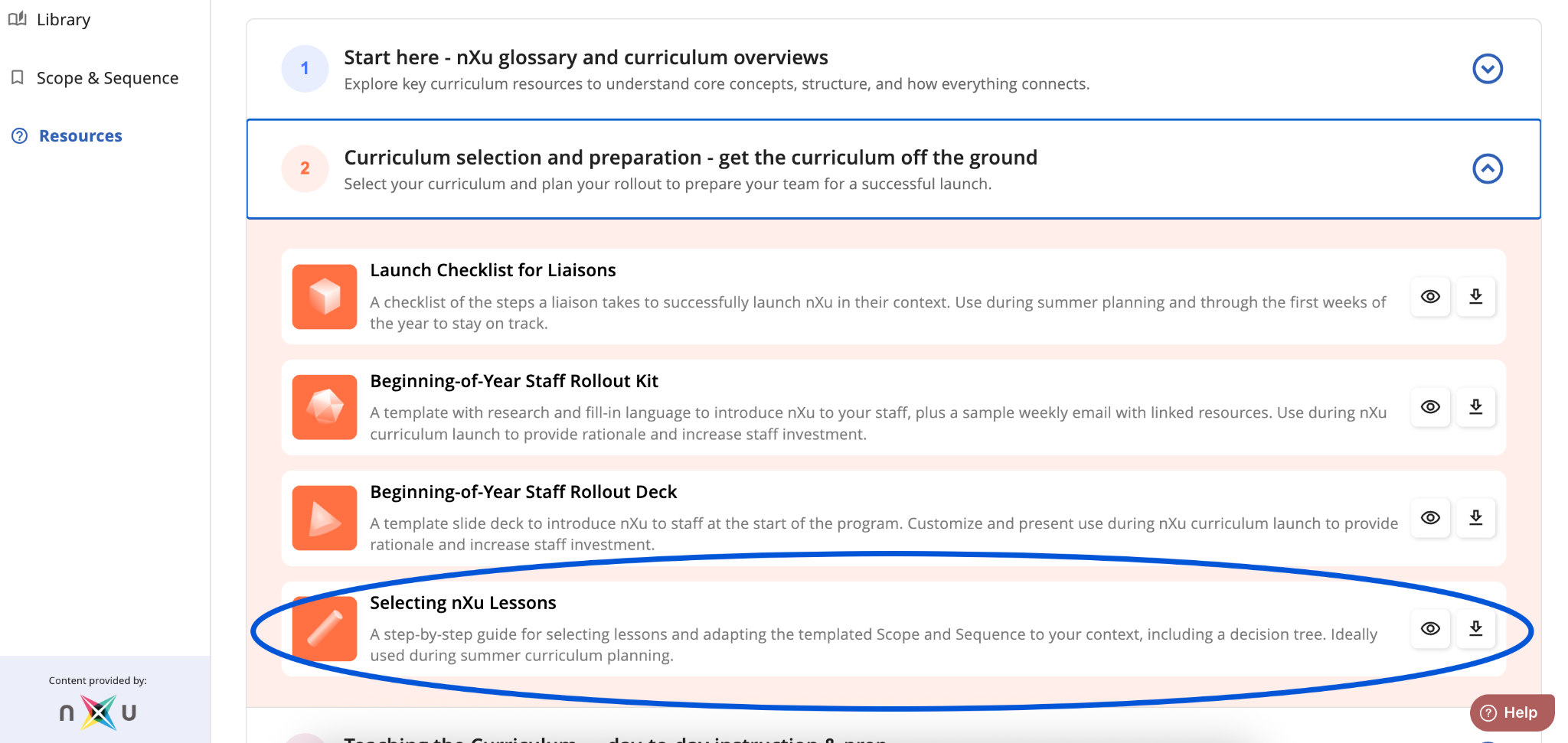
This guide includes a decision tree that helps you determine which Scope & Sequence is the best fit based on:
The age of your students
Your instructional goals
The amount of time available
Whether you are focusing on Durable Skills or College & Career Readiness
Once you've answered the questions, you'll be directed to a recommended templated Scope & Sequence, which you can copy, download, refine, and share with colleagues. Each Scope & Sequence contains a carefully curated set of lessons designed to build skills in a logical progression while providing flexibility for different implementation models.
Then use Step 3: Finalize Your Scope and Sequence to personalize to your school specifications.
Secondary Option 2: Build Your Own Scope & Sequence (Grades 6–12)
Every classroom has different priorities, and the lesson library is built to support that flexibility. If you'd like more flexibility, you can create your own lesson sequence. To do this:
Whether you're looking for a specific lesson or simply exploring possibilities, the library is designed to help you build an experience that's right for your classroom.
Review the nXu Curriculum Library including module descriptions with grade-level recommendations. For lesson level review, use the search bar and filters to quickly find lessons that align with your instructional goals, your students' needs, or the skills you want to develop.
Identify the modules that best align with your students' needs and your instructional goals.
Select the lessons you'd like to include from those modules.
Because many skills build upon one another, sequencing lessons thoughtfully will help students get the greatest benefit from the curriculum.
As you build your own sequence, we recommend referencing the Step 3: Finalize Your Scope and Sequence of the Selecting nXu Lessons guide, which provides planning guidance and recommendations for creating a balanced learning experience for your school specifications.
Choosing Lessons for Elementary (Grades K–5)
Elementary lessons are designed to be taught in a recommended order. Each grade level builds progressively on concepts introduced earlier in the year, so we recommend following the grade-level sequence whenever possible.
The recommended modules for each grade are:
Within each module, lessons are intended to be taught in order, as each lesson builds on previous learning and prepares students for the next concept.
If your schedule requires flexibility, individual lessons may be used independently, but following the recommended sequence provides the strongest learning experience.
If you have questions about accessing the Overgrad platform or other technology-related issues, please contact support@overgrad.com.
If you have questions about the nXu curriculum, assessments, training, or implementation, please contact support@nxueducation.org.
Was this article helpful?
That’s Great!
Thank you for your feedback
Sorry! We couldn't be helpful
Thank you for your feedback
Feedback sent
We appreciate your effort and will try to fix the article